Executive Summary
For growing NGOs, operational complexity rarely comes from one department. It appears at the points where finance, procurement, people, projects, expenses, inventory and approvals depend on each other.
This case study explores how an Africa-based NGO moved toward a more connected operating model with Odoo ERP—centralizing information, structuring approvals and creating clearer workflows across major operational functions through an end-to-end Odoo implementation.
The Core Objective
The goal was not simply to install another business application. It was to create a practical digital foundation where teams could work from consistent information and management could gain a clearer view of operations.
The Challenge: Growth Created Operational Complexity
As the organization expanded, different teams were managing activities through spreadsheets, email, manual records and separate processes. Individual departments could complete their work, but the handoffs between departments were harder to control.
- Repeated data entry across different records
- Manual follow-ups for approvals and pending actions
- Limited visibility across departments
- Inconsistent or duplicated operational information
- Time-consuming consolidation for management reporting
- Difficulty tracking where a transaction or request stood in its lifecycle
The underlying requirement was therefore broader than software replacement: the organization needed connected processes.
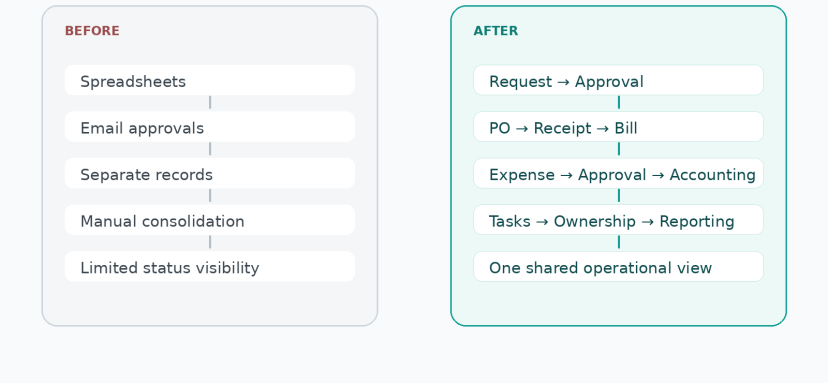
From fragmented work to connected workflows
Start With the Operating Model—Not the Software
The implementation approach began by understanding how work actually moved through the organization: who initiated requests, who approved them, which departments depended on each other, what information was created at each stage, and where repetitive manual work was occurring.
This is how an experienced Odoo implementation company scopes Odoo ERP implementation services for an NGO: the processes are mapped first, and the system is configured around them.
The Odoo ERP Ecosystem
Rather than treating ERP modules as isolated applications, the solution focused on connecting workflows between functions.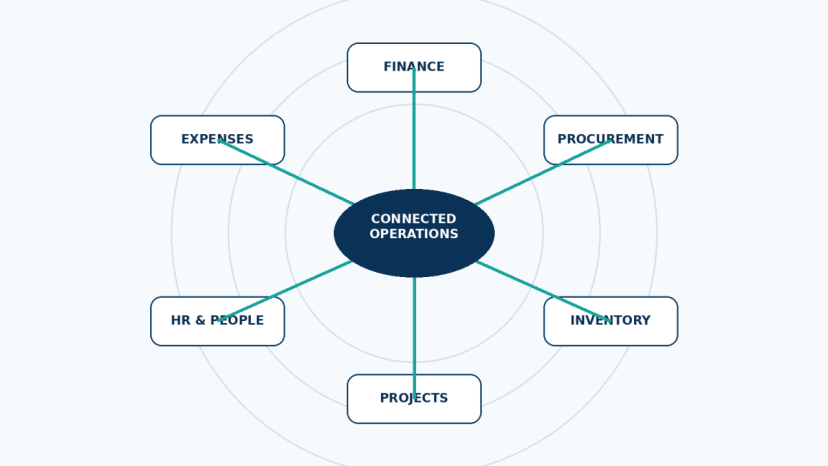
Finance & Accounting
Financial activity could be connected more closely with purchasing, expenses and operational transactions, reducing the need to consolidate information manually from separate sources. This is where Odoo Accounting module implementation delivers its value for NGOs.
Procurement & Purchasing
Purchase requests, approvals, purchase orders, receipts and vendor bills were organized into a clearer process with ownership and status visibility.
Inventory Management
Products, receipts, internal movements, deliveries, stock availability and adjustments could be managed within the same operational environment through Odoo Inventory management implementation.
Connecting People, Projects and Expenses
Human Resources & Employee Management
Employee information and HR activities were brought into a more structured environment, reducing reliance on disconnected employee records. Odoo HR module implementation gave the organization one reliable place for people data.
Expense Management
Expense submission, review, approval and financial processing could follow a defined workflow rather than relying heavily on email follow-ups.
Project Management
Projects, tasks, responsibilities, activities and deadlines could be organized within Odoo to give teams and management a clearer view of ongoing work.
CRM & Partner Management
Partner and stakeholder information could be maintained centrally, supporting a more consistent view of important relationships.
Approvals & Workflow Automation
Defined approval stages replaced informal approval chains, making responsibility, status and pending actions easier to track. Odoo workflow automation turned these approval stages into a repeatable NGO workflow automation model.
Where the Value Really Appears: Connected Workflows
The strongest value of an ERP implementation is often created at the handoffs. A purchase can progress from request to approval, purchase order, receipt and accounting. An employee expense can move from submission to approval and then financial processing. Project activities can connect people, tasks and operational information.
Instead of separate departmental processes, the organization gains a more connected operational flow.
Business Impact
The transformation created a more centralized, structured and transparent operating environment. The case study supports the following operational improvements:
AREA | OPERATIONAL VALUE |
One operational platform | Major activities can be managed within a common system. |
Less spreadsheet dependency | Teams can reduce reliance on disconnected spreadsheets and manual records. |
Structured approvals | Requests can move through defined approval stages. |
Better visibility | Management can access information from connected operational functions. |
More consistent data | Centralized records reduce duplication and conflicting information. |
Easier reporting | Less manual consolidation is required before management review. |
Scalable foundation | The platform can support future automation, integrations and process refinement. |
Standard Odoo First. Customization Where It Matters.
A sustainable Odoo implementation should use standard functionality wherever it can meet the business requirement. Custom development should be introduced where a genuine organizational need cannot be addressed effectively through configuration or standard workflows—through targeted Odoo customization services such as Odoo custom fields and workflows or custom Odoo module development.
This approach helps balance flexibility with maintainability and long-term scalability. Keeping upgrade-safe Odoo custom code also means future Odoo upgrade services remain simpler and lower risk.
Why Odoo Can Be a Strong ERP Foundation for NGOs
NGOs often need to coordinate finance, people, projects, procurement, inventory, expenses, partners and reporting while maintaining clear accountability. A connected ERP can help bring these activities into a common operational framework, which is why Odoo ERP for NGOs is increasingly considered as NGO management software and a practical nonprofit ERP.
The value is not simply the number of applications available. It is the ability to connect those applications into workflows that reflect how the organization actually operates.
A Practical Odoo Implementation Framework
- Understand Map the current operating model and key handoffs.
- Analyze Identify duplication, bottlenecks and manual work.
- Design Create practical workflows around real operational requirements.
- Implement Configure standard Odoo and customize only where justified, with Odoo data migration and validation and Odoo go-live support.
- Connect Link departments, information and approval flows—and, through Odoo integration services, connect Odoo with third-party systems.
- Optimize Continuously improve automation, reporting and user experience.